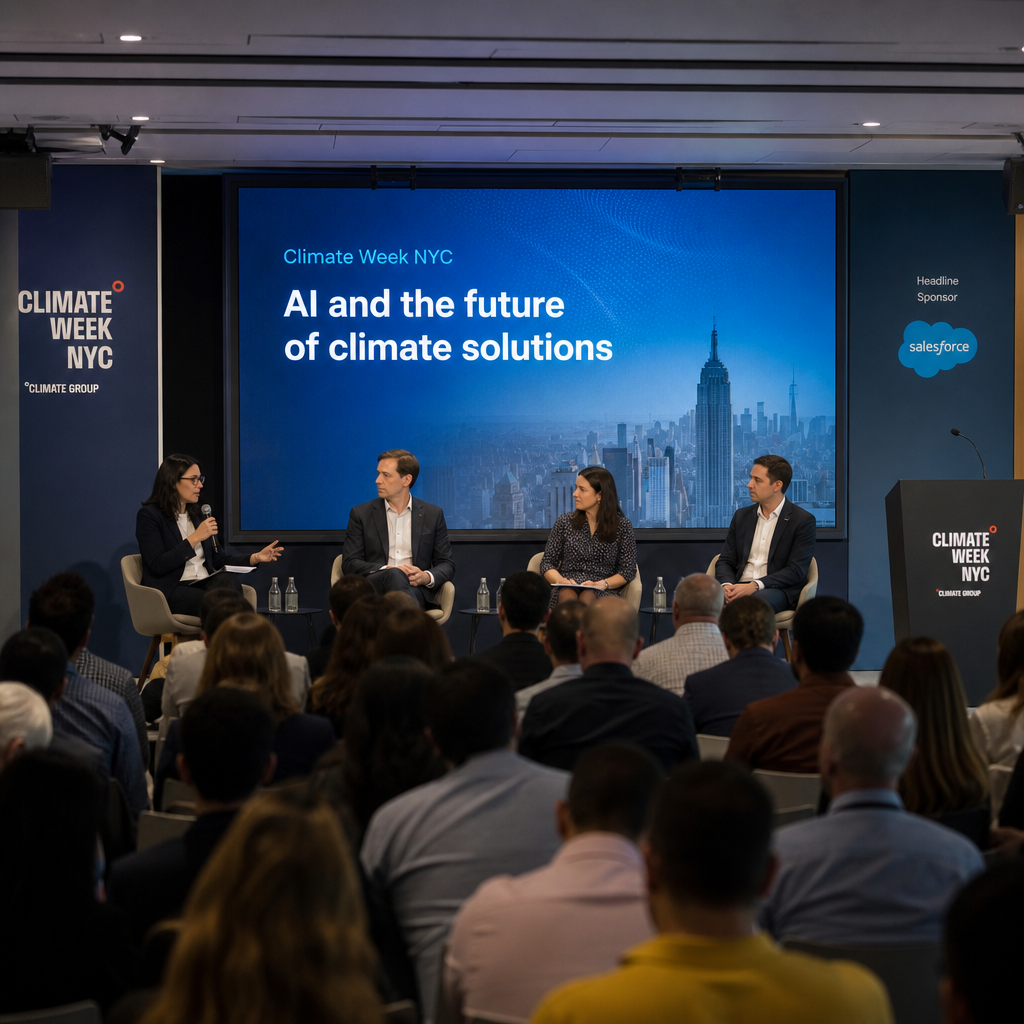
AI Taking Center Stage at Climate Week: Innovations, Challenges, and the Future
As the global climate crisis intensifies, the conversation around how technology can be leveraged to combat these changes is more crucial than ever. Surprisingly, at this year’s Climate Week, Artificial Intelligence (AI) has emerged as a dominant theme, generating anticipation and discussions across sectors.
The question is, why AI? Traditional methods alone seem insufficient to address the complex, multifaceted issues of climate change. AI offers a promise of unveiling patterns and solutions that humans might overlook, transforming how we tackle the environmental challenges of our time.

The Role of AI in Climate Solutions
AI plays an integral role in modern climate solutions. From optimizing energy consumption in smart grids to predicting environmental changes, its applications are vast.
Optimization of Renewable Energy
AI algorithms optimize the distribution and storage of renewable energy sources like solar and wind. By predicting weather patterns, AI can better forecast energy availability, reducing waste and improving efficiency.
Predictive Analytics for Environmental Monitoring
AI’s predictive analytics capabilities help in monitoring deforestation, tracking endangered species, and projecting future climate scenarios to inform policymaking and public initiatives.
- Data-driven insights enhance decision making.
- Real-time monitoring of ecological changes.
- Improved resource management and conservation efforts.
Challenges Facing AI Integration in Climate Solutions
Despite its potential, integrating AI into climate solutions comes with its challenges. The primary concerns include data quality, computational cost, and scalability.
Data Quality and Access
AI systems require vast amounts of accurate data. In the case of climate solutions, data may be scarce, fragmented, or unreliable, impacting the efficacy of AI models.
Computational Demands
AI requires significant computational power, which can be expensive and resource-intensive. This raises concerns about its environmental impact, counterintuitive to its purpose.
Spotlight on Recent Breakthroughs
Recent breakthroughs in AI offer promising prospects for enhancing climate solutions.
AI-Powered Carbon Capture Technologies
Technologies that deploy AI to optimize carbon capture processes are gaining traction. These systems enhance efficiency, significantly reducing emissions.
AI in Climate Modeling
AI aids in creating complex climate models that can simulate long-term ecological impacts, providing insights with unprecedented precision.
Future Prospects: AI and Climate Action
Looking forward, the future of AI in climate action appears promising, yet contingent on responsible integration.
AI’s potential to revolutionize climate response lies in its collaborative use across disciplines and transparent policy engagement. This ensures that ethical and environmental standards complement technological advancements for sustainable growth.
The Path Ahead
Collaboration remains key to unlocking the full potential of AI in climate solutions. By integrating cross-sector expertise, the promise of AI can be maximally realized.
The challenge is to foster an environment where AI complements human efforts, enhancing and accelerating actionable responses to the critical climate crisis.
AI’s Impact: A Summary
| AI Application | Impact |
|---|---|
| Renewable Energy Optimization | Reduces energy waste and improves efficiency |
| Environmental Monitoring | Enhances real-time insights and predictive capabilities |
| Carbon Capture Technologies | Optimizes emission reduction processes |
| Climate Modeling | Provides precise projections and scenario planning |