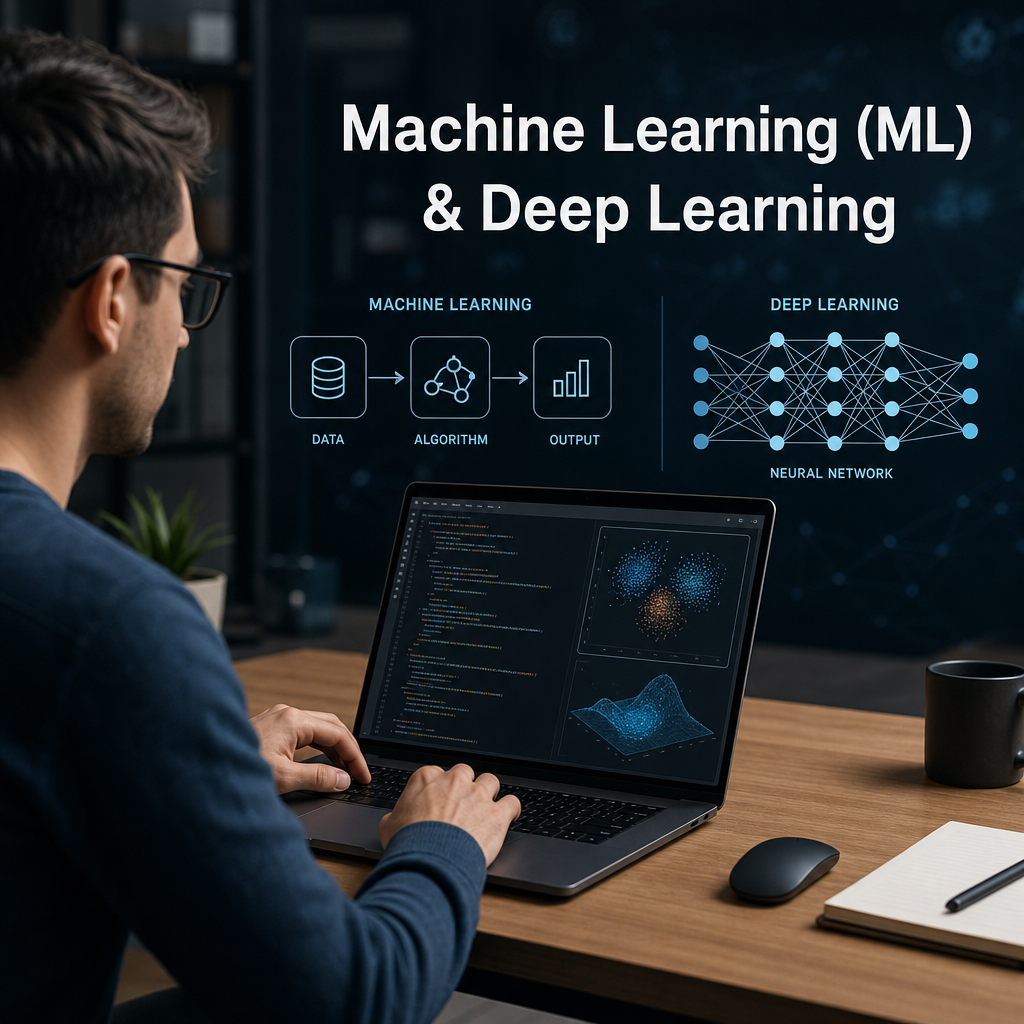
Unlocking the Mysteries: Exploring Machine Learning and Deep Learning
It wasn’t too long ago that the concepts of Machine Learning (ML) and Deep Learning seemed like scenes from a sci-fi movie. What were once distant fantasies embedded in futuristic narratives are now everyday realities impacting various sectors of our lives. But what truly lies behind these buzzwords that are revolutionizing the digital age?
Machine Learning and Deep Learning are not just technological advancements; they are the engines driving a new era of human progress. This article delves into how these technologies function, their differences, their real-world applications, and their implications on the future of mankind.

Understanding Machine Learning
Machine Learning, at its core, is a subset of artificial intelligence that equips computers with the ability to learn from data without being explicitly programmed. This might sound complex, but it’s essentially about teaching computers patterns by feeding them data and allowing them to make decisions based on that data.
To comprehend Machine Learning, it’s useful to categorize its types: supervised learning, unsupervised learning, and reinforcement learning, each with its specific use cases and techniques.
Types of Machine Learning
- Supervised Learning: In this type, models are trained on a labeled dataset, which means that each training example is paired with an output label. It’s heavily utilized in prediction models such as spam detection, stock price prediction, and more.
- Unsupervised Learning: Here, algorithms are used against data that has no labeled responses. This type identifies hidden patterns from the input data, with clustering and association being popular methods used for customer segmentation, anomaly detection, etc.
- Reinforcement Learning: It mimics the process of learning from consequences through trial and error. This type is common in robotics, gaming, and navigation applications.
Diving into Deep Learning
Deep Learning, a subset of Machine Learning, aims to emulate the function of the human brain in processing data and creating patterns for decision-making. The ‘deep’ in deep learning refers to the multiple layers through which data is transformed before coming up with a prediction.
The primary structure of a deep learning model is the neural network. Let’s look at a simple representation of how a neural network can recognize and process images.
Components of Neural Networks
- Input Layer: This layer is responsible for collecting the data input that needs processing.
- Hidden Layers: The input data flows through one or more hidden layers, where computations are performed to detect, extract, and compute sophisticated features.
- Output Layer: Ultimately, the processed data lands onto this layer, resulting in a prediction outcome.
| Aspect | Machine Learning | Deep Learning |
|---|---|---|
| Data Dependency | Can perform well with less data | Requires a large volume of data |
| Interpretability | More interpretable | Considered as black boxes, hard to interpret |
| Computation | Less computation needed | High computational requirements |
Real-World Applications
The application of Machine Learning and Deep Learning spans across a myriad of industries, reshaping how operations are conducted and improving outcomes in unprecedented ways.
From healthcare to finance, transportation to entertainment, let’s explore some exemplary use cases that showcase the impact of these technologies.
Healthcare
- Medical Imaging: Deep learning models enhance the accuracy of disease detection in radiological images, assisting in early diagnosis.
- Predictive Analysis: Machine Learning models predict patient admissions, optimizing healthcare resource allocation.
Finance
- Algorithmic Trading: Predictive algorithms analyze massive datasets for profitable trading opportunities.
- Fraud Detection: Both ML and DL models help in identifying fraudulent transaction patterns in real-time.
The Future of ML and DL
The evolution of Machine Learning and Deep Learning is set to drive innovation in ways unimagined. These technologies promise to propel us towards a future powered by intelligent systems that optimize and personalize our digital experiences.
However, with growing capabilities also come challenges related to ethics, data sovereignty, and the need for regulatory frameworks to ensure the benevolent application of these technologies.